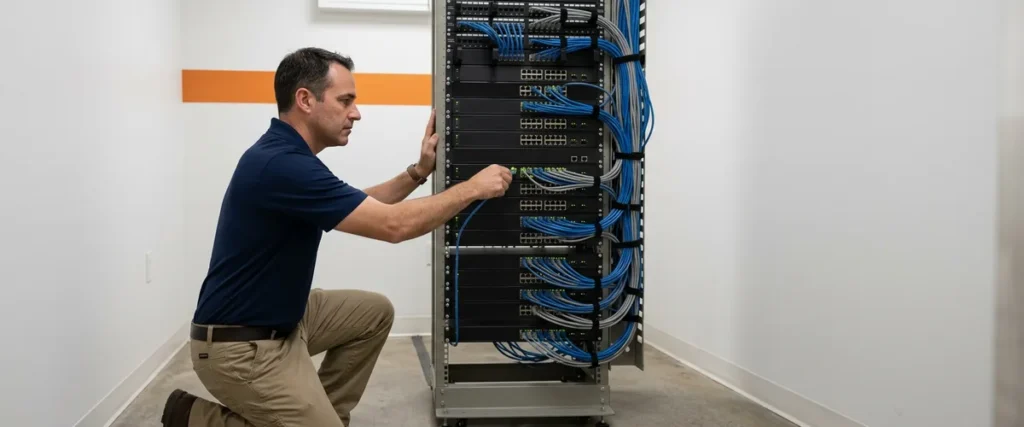

Helion Technologies combined a 10-store Texas dealer group’s three networks into one, raising data throughput by a factor of more than 1,000 and cutting network spending from an average of $62,300 a month to $25,000, a 60% reduction.
Last updated: November 16, 2026
Ten stores, split between the Houston and Dallas areas, and a leadership team that needed to meet. Traffic in both cities was congested, and the case study we wrote about this group says it could take hours to get between stores in the same city, “let alone the half-day or more that it takes to drive or fly between the two cities.” Meetings had become “a major drain on managers’ and partners’ time.” That’s a cost no vendor ever sends you a bill for.
Helion Technologies is a managed IT, cybersecurity, and compliance provider in Baltimore that has worked only with automotive and heavy truck dealerships since I founded it in 1997, and running every store in a group on one standard network build is part of our managed IT support for dealerships. We support 2,000-plus dealerships today.
Fair warning, this story is old. The case study we published on it has been around for years, and every figure and quote about this group comes straight from it, with the quotes from the group’s CFO and COO as they were written. The network came first. A year later it made group-wide video meetings practical, and that’s what most of the case study is about.
If the bigger question for your group is how many IT companies you pay and who owns the result, our page on dealership IT vendor consolidation takes that on directly. This post stays with the network and what it made possible.
Dealership Network Consolidation by the Numbers
Here’s the before and after, straight from the case study.
| What changed | Before | After |
|---|---|---|
| Networks | Three | One |
| Monthly network cost | An average of $62,300, paid to several different vendors | $25,000, a 60% reduction |
| Data throughput | What the three old networks could carry | More than 1,000 times that |
| Video meetings | An outdated and largely unused videoconferencing system | A high-definition video meeting system, with large screens in the conference room at each of the 10 stores |
| Getting managers together | Hours between stores in the same city, and a half-day or more between Houston and Dallas | A monthly finance meeting, weekly service meetings, and training, held by video |
What Was All That Driving Costing the Group?
More than gas. “The cost of flying everyone to one location is one thing, but even more costly are the lost opportunities,” the group’s CFO said. “For every day that a manager is out of the store, that’s probably three or four sales or deals that don’t get done.” Three or four deals a day, per manager, by his own estimate. I can’t beat that math.
He was just as clear that the meetings had to happen anyway. “Meetings are a necessary part of business; we need to connect with all of our GMs, partners and managers on a regular basis,” he said. Phone calls weren’t cutting it, either. What the group needed, in the case study’s words, was a way of connecting team members “that had the impact and immediacy of a face-to-face meeting and the logistics of picking up the phone.” That’s a tall order. It started with the network.
How Did Helion Turn Three Networks Into One?
The network work came a year before the video project. We upgraded the group’s three networks and combined them into one, and data throughput went up by a factor of more than 1,000. Before the upgrade, the group paid an average of $62,300 a month to several different vendors. The new network cost $25,000 a month. That’s 60% less.
The case study doesn’t describe the build. So I won’t either. Having several vendors behind three networks is what I’d look at first in any group. When a store drops offline in a setup like this, who owns that? It can be nobody. That’s the mess.
Today we put every store in a group on the same standard build through our dealership network management, down to the device names.
One network did more work for less money than three.
What Did the Faster Network Make Possible?
Video, mostly. The extra throughput let the group upgrade an “outdated and largely unused” videoconferencing system, and on our recommendation it chose a high-definition video meeting system. We set it up with large video screens in the conference room at each of the 10 stores.
“Our videoconference meetings are like being there in person, and when all the managers and partners get together, it’s like having a mini 20 group,” the group’s COO said. Then he added the line I’d underline for any dealer principal: “Participants make suggestions to solve problems and try new processes, which has helped generate additional revenue.” That’s the payoff.
If you haven’t sat in one, a 20 Group is a peer group of dealers who don’t compete with each other. NADA’s 20 Group program places members by “franchise, dealership department, sales volume, location, travel preferences and budget,” its in-person groups meet three times a year, and NADA says many dealers consider their 20 Group peers their “board of directors.” This group got its own version every week. Nobody had to fly.
Video still leans on the network today. If your managers meet on Microsoft Teams, Microsoft’s network planning guide for Teams says that “when bandwidth is insufficient, Teams prioritizes audio quality over video quality.” So a thin connection can quietly turn a video meeting back into a conference call, the format this group’s CFO said could never carry its most important meeting.
The network was the price of admission.

Which Meetings Moved Off the Road?
Four kinds of meetings moved to video once the network could carry them: the monthly finance meeting, the weekly service meetings, training, and one-on-one calls. The finance meeting alone brought in more than 60 people, and the CFO called it the most important meeting the group held.
- The monthly finance meeting. More than 60 sales and finance managers, GMs, and partners went through numbers, policies, incentives, and more. “With that many people, you know some of them would just hit mute and continue to work while others are speaking,” the CFO said about running it as a conference call.
- Weekly service meetings brought service managers, used car managers, partners, and GMs together on numbers, opportunities, advertising, and goals. The COO liked them for problem solving: “If a manager at one location has a difficult situation, other managers can chime in and talk about how they solved that problem.”
- Accountability. “Another benefit of this meeting is it brings accountability,” the CFO said. “Every month the service managers announce three things they’re going to work on next month, and they make that commitment in front of everyone.”
- The healthcare rollout. “It would have taken three or four days and a lot more paperwork,” the CFO said of doing it store by store. Over video, the HR managers, controllers, and partners finished the rollout training in two hours.
- One-on-ones. “I use the system just about every day, not just for meetings but also one-on-one calls,” the COO said.
Same meetings, less highway.
Where Did the CFO’s $1 Million Estimate Come From?
From the CFO himself. Once the system was running, he estimated that the group “has added $1 million to its bottom line,” according to the case study. It gave seven reasons. Only one of them is the network.
| What the case study credits | Network or meetings |
|---|---|
| “Reduced travel time and costs” | Meetings |
| “Increased productivity and sales as a result of reduced travel time” | Meetings |
| “A more efficient data network which reduced costs by 60%” | Network |
| “Improved problem solving, accountability, and process improvements as a result of 20 group-like meetings” | Meetings |
| “Strengthened rapport between store managers and partners” | Meetings |
| “Ability to access meetings remotely from a variety of devices” | Meetings |
| “High adoption rates thanks to flexibility and ease-of-use” | Meetings |
The COO put it plainly. “It strengthens rapport and you get to know people better, as if you’re working in the same location,” he said. His last line in the case study: “It’s like being in the same room; the only thing you can’t do is shake hands.”
Video meetings aren’t news anymore, and I’m not here to sell you on them. The order is the lesson. They paid for a better network first, and a year later the meetings ran on a network that already cost 60% less than the old ones.
The savings started with the network.

Before You Merge Your Group’s Networks
Is a 60% cut normal when a group merges its networks?
Should we expect $1 million from a project like this?
How long did the network project take?
Does the same approach work for a heavy truck group?
How Do We Consolidate IT, Phone, and Security Vendors Across Our Dealer Group?
Add up what every store pays for IT, phones, internet, and security before anyone quotes you. Put that total next to one accountable team’s all-in price, and then move the pieces over in an order you approve, one store at a time. Your DMS provider and your carriers stay where they are.
Helion Technologies does this for dealer groups under one contract and one standard. Our IT services for dealer groups hold every rooftop to it, the next store you buy included, and we work with the vendors that stay.
- Pull the bills. This group’s network ran an average of $62,300 a month across several vendors, and that was just the network. Our dealership IT vendor inventory worksheet gives each vendor its own row.
- Put one all-in price next to that total. If a provider won’t show you both numbers side by side, keep looking.
- Ask what the network has to carry next. For this group it was video. If your stores still send their internet traffic back through one main office, read Microsoft’s connectivity guidance for Microsoft 365 first; it says enterprise WANs “are often designed to backhaul network traffic to a central company head office for inspection before egress to the internet,” and it recommends local internet egress instead.
- Who decides the order? You do. We change one store first and give it time before the others.
- Keep the carriers and the DMS provider, and track their renewal dates.
Add it up first. Then decide.

Count the Networks, Then the Bills
If your stores are in Texas, our pages on dealership IT services in Dallas-Fort Worth and dealership IT services in Houston cover how we support dealerships in both metros. Wherever your group is, the first step is the same. Our Complimentary IT & Cybersecurity Assessment is a no-cost, no-obligation review of your current technology, security posture, and vendor spend, and it stacks your current bills across every vendor against what a single accountable team would cost. The findings come back to you in a written report.
Count your networks before you sign anything new.