
Managed IT
Dealership IT Vendor Consolidation: One Accountable Team
The help desk, network, phones, security and compliance under one standard, instead of five vendors each pointing at the next one.

Dealership IT vendor consolidation means moving the help desk, network, phones, security and compliance from several separate vendors to one team that answers for all of it. Helion Technologies does that for dealerships, and works alongside the vendors that stay.
Last updated: October 29, 2026
Why Dealership IT Vendor Consolidation Comes Down to Accountability
Nobody sets out to hire five IT vendors. A store buys cybersecurity from one company because an OEM asked about it, network support from another because that’s who put in the firewall, and phones from a third when the old contract ran out. Then a compliance vendor shows up after a Safeguards scare. Each of those made sense on the day it was signed. Together, though, they leave a system that nobody owns.
That’s the setup our managed IT for dealerships was built to replace. We take the help desk, network, phones, security and compliance into one contract under one standard, and we work with the vendors that stay, like your DMS provider and your carriers. If you have IT staff you want to keep, co-managed IT puts them on the same team instead of out the door.
Five vendors, five versions of the story. One team, no finger-pointing.
What Breaks at the Seams Between IT Vendors
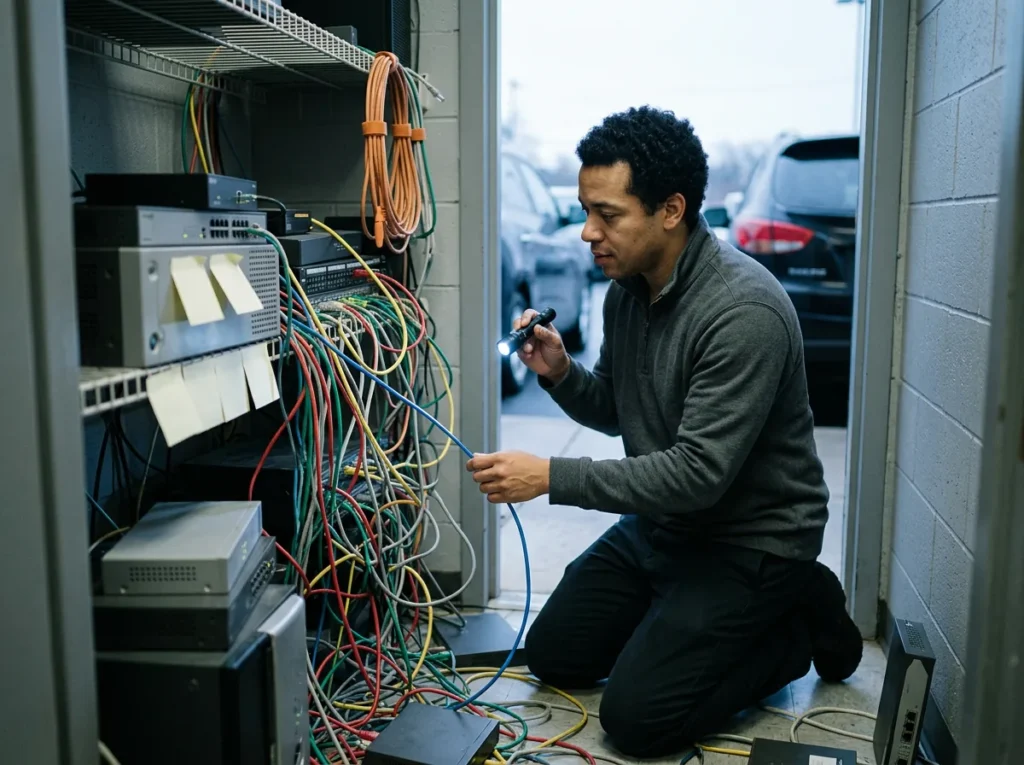
Scot McConnor, who leads technology advisory for us, says the story he hears on first calls barely changes from one dealer to the next. It’s Saturday, the phones at one store keep cutting out, and the service drive is trying to confirm appointments. The network company tells the GM it’s the phone system. The phone company says it’s the internet, and the carrier will send someone, but not until Wednesday. Nobody’s lying, exactly. The problem just doesn’t belong to anyone.
Phones are just the easy example. The same thing happens when a security tool blocks a program the shop runs every day, or when a new F&I manager needs logins set up by three different companies. A dealership runs on a long list of vendors, and over the years our team has learned how they tend to interact, so plenty of these get fixed without anyone waiting on the other vendor to call back.
The trouble lives in the handoff.
Phones and internet
Choppy calls bounce between the phone vendor, the network vendor and the carrier while customers hang up.
One ticket owns it.
Security and shop software
A security tool flags a program the service department relies on, and two vendors each wait for the other.
Someone decides.
People coming and going
A new hire needs a computer login, email and a phone extension, and someone who leaves needs every one of them shut off.
One checklist, every login.
One Team Behind 2,000+ Dealerships
Those numbers come from one team, not a referral list. Our help desk is open whenever dealers are open, 7 days a week, and security support runs 24/7, with live, US-based analysts who step in the moment they see signs of an attack. Both sit with the people who run your network and your phones. When something breaks, there’s nobody else to blame. That’s on purpose.
Line by line
How We Consolidate Dealership IT Vendors, One Bill at a Time
Erik Nachbahr, our founder and president, says most dealers he meets don’t really have an IT budget. So the first thing we do is look at everything they’re spending money on and bring it together in one place. Every invoice then lands in one of two piles. Some of it folds into one Helion contract. The rest stays where it is, and we keep track of it for you.

Planning next year’s IT spend?
Our dealership IT budget checklist covers the line items dealer groups tend to miss, from license true-ups to hardware that’s aging out.
The bill audit What happens to each line you pay for
Help desk Who your people call
Sometimes it’s an MSP, and sometimes it’s one in-house person with a list of support numbers for everything they can’t fix themselves. We look at what you pay for support today and who actually picks up. With us it’s one help desk for every department and every rooftop, staffed by people who only work with dealerships.
Folds in. One number to call.
Network Firewalls, switches and Wi-Fi
The firewall was installed by one company, the Wi-Fi by another, and the switches in the parts room were bought online by someone who’s since left. We move the circuits, firewalls, switches and Wi-Fi at every store onto one standard build through our dealership network management.
Folds in. One standard build.
Phones The phone system on top of it
Phones ride on the network, so splitting them from the network is where most of the blame starts. The separate phone vendor goes, and the dealership phone system becomes part of the same team that runs the cabling and the circuit underneath it. Same numbers, one ticket.
Folds in. No more phone versus network.
Security Tools bought one at a time
Endpoint protection came from one place, email filtering from another, and maybe a monitoring service an OEM recommended a couple of years ago. We replace that pile with one cybersecurity program for dealerships, including advanced endpoint detection and response, email security, and 24/7 security support from a live, US-based team.
Folds in. One program, one owner.
Compliance Safeguards work and vendor reviews
The FTC Safeguards Rule asks you to oversee your service providers, which means picking ones that can protect customer information, requiring safeguards in the contract and checking on them from time to time. Fewer vendors make that list shorter. Our Continuous Compliance program pulls the vendors that remain into one place and rates each one on how it handles your data.
Folds in. A shorter list to check.
Carrier and ISP Circuits and carrier contracts
These stay, since you still need internet circuits and phone lines from a carrier. What changes is who watches them. Once the other vendors are down to one, Scot’s team keeps track of your carrier, ISP and phone service contracts as part of account management, renewal dates included. Our post on lowering phone and internet carrier bills shows where those contracts usually leak money.
Stays. We track the dates.
DMS Your DMS and the software on it
Your DMS provider owns the DMS and its implementation. We own the environment it runs in, meaning the network, the PCs and printers, the user accounts and the security, and we work with the provider’s team instead of around it. When a ticket comes in, we help sort a network or device question from a DMS configuration question so it reaches the right people fast. As a Tekion Referral Advisory Partner, our Tekion enablement team gets the dealership ready for go-live and drives adoption after it, and our DMS transition work does the same for any platform change.
Stays. We work alongside it.
Side by side
Five IT Vendors or One Team: What Changes for the Dealer
This is the comparison dealer principals and CFOs ask us for most. It isn’t about which vendor is good at its piece, since several of them probably are. It’s about what happens between the pieces, and what that costs in time, money and exposure.
| Situation | Five separate vendors | One team at Helion |
|---|---|---|
| Something stops working | Each vendor checks its own piece first, then points you at the next one | One ticket, owned by the team that runs every piece, so nobody hands it off |
| Who your staff call | A different support number for each vendor, and someone has to guess which | One help desk, where a live technician answers in 82 seconds on average |
| Admin access to Microsoft 365 | Several outside companies may hold admin rights, and nobody reviews the list | One partner, with access limited to what the work needs |
| Contracts and renewals | Five renewal dates and five auto-renew clauses in five different folders | One contract, with the carrier and ISP dates tracked for you |
| Planning for replacements | Each vendor quotes its own piece when something wears out | An annual budget that looks 5 to 7 years ahead at PCs, firewalls and network gear |
| How things get built | Every vendor sets things up its own way | One standard at every rooftop |
On the access row, Microsoft lets a partner hold granular, time-bound admin access to a customer’s Microsoft 365, and the customer has to grant it explicitly. The fewer companies on that list, the easier it is to know who can get in. Our page on Microsoft 365 management and security covers the rest. Fewer logins, fewer doors.
How Dealership IT Vendor Consolidation Works With Helion
-
1
Ask for the assessment
Fill in the short form for our complimentary IT and cybersecurity assessment. It’s free, and it covers every rooftop you run.
-
2
Bring every bill
We look at the network, the DMS setup and the security at each store, and we ask for every IT, phone, internet and security invoice and contract you pay.
-
3
See both totals
You get written findings, with what you pay all of your vendors today next to what Helion would cost all-in. Some dealers land near even. Others don’t.
-
4
Consolidate, then track
We move each piece onto one standard in an order you sign off on, then track the contracts that stay. Onboarding starts within weeks of signing.
Common Questions

Want every bill looked at?
Our complimentary IT and cybersecurity assessment puts what you pay every IT vendor today next to what we’d charge. Already know what you need? Get a price quote.
What is dealership IT vendor consolidation?
We already have an MSP. Why would we switch?
Does consolidating IT vendors save a dealership money?
What happens to our in-house IT manager?
Which vendors don’t get consolidated?
How long does it take to move to one IT team?
Send us every IT bill. We’ll show you what one team would cost.
Request a Complimentary Assessment →