
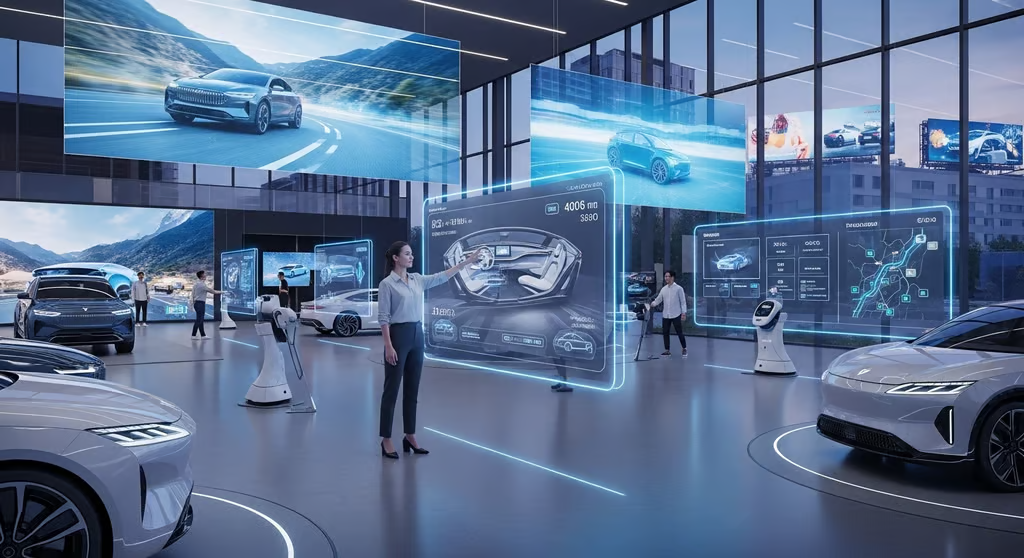
Technology has always been an important part of dealership operations, but today it has become a competitive advantage.
The modern dealership isn’t defined by the software it owns—it’s defined by how effectively technology supports the business. Artificial intelligence (AI), cybersecurity, cloud platforms, data governance, and compliance have become strategic assets that influence profitability, customer experience, operational efficiency, and long-term growth.
To compete in today’s market, dealerships need more than updated hardware or a newer Dealer Management System (DMS). They need a secure, scalable technology foundation that enables innovation while protecting the business.
In this article, we’ll explore what defines a modern dealership, the technology investments that matter most, and how dealerships can prepare for an AI-driven future.
What Is a Modern Dealership?
A modern dealership uses technology as a strategic business asset rather than simply an operational necessity.
Instead of reacting to technology problems as they occur, modern dealerships proactively invest in cybersecurity, cloud infrastructure, data governance, compliance, automation, and long-term technology planning. Every department—from sales and service to accounting, fixed operations, F&I, and executive leadership—depends on technology to operate efficiently and make better decisions.
Technology is no longer just about keeping systems online.
It’s about helping the dealership become more profitable, more secure, and more competitive.
Why Technology Strategy Matters More Than Ever
Not long ago, dealership technology was relatively straightforward.
Maintain the DMS. Keep the network running. Protect against viruses. Verify backups. Replace aging computers.
Today’s environment is dramatically different.
Dealerships are rapidly adopting artificial intelligence, cloud applications, advanced analytics, connected customer experiences, and increasingly sophisticated cybersecurity technologies. At the same time, regulators and OEMs continue to raise expectations around cybersecurity, data privacy, and compliance.
Leadership teams are asking new questions:
- How can AI help us become more efficient?
- Should we deploy Microsoft Copilot?
- How do we safely use generative AI?
- Can we combine data from multiple systems for better business intelligence?
- How should we prepare for evolving OEM cybersecurity requirements?
- What technology investments should we prioritize over the next three years?
These aren’t IT questions.
They’re business strategy questions.
Answering them requires a modern technology strategy—not simply technical support.
Five Pillars of the Modern Dealership Technology Strategy
1. Cybersecurity Comes First
Every technology initiative begins with trust.
Whether you’re deploying AI, migrating applications to the cloud, integrating new business systems, or expanding digital customer experiences, cybersecurity can no longer be treated as an afterthought.
Modern dealerships should implement multiple layers of protection, including:
- Endpoint Detection and Response (EDR)
- 24×7 security monitoring
- Multi-factor authentication (MFA)
- Identity-first security
- Modern firewalls
- Email security
- Reliable backup and disaster recovery
- Ongoing security awareness training
- Vulnerability management
Cybersecurity isn’t simply about preventing ransomware or data breaches.
It’s about creating an environment where the business can confidently innovate.
2. Cloud Infrastructure Enables Growth
Cloud technology has fundamentally changed how dealerships operate.
Applications once hosted on local servers increasingly live in secure cloud environments, allowing employees to collaborate from anywhere while simplifying software updates, scalability, and disaster recovery.
Microsoft 365 has evolved far beyond email. It has become the productivity, collaboration, identity, and increasingly AI platform for many dealerships.
Organizations that modernize their cloud environment are better positioned to:
- Improve employee productivity
- Simplify collaboration across departments and rooftops
- Support remote work
- Reduce infrastructure complexity
- Adopt AI technologies such as Microsoft Copilot
Cloud modernization isn’t simply an IT upgrade.
It’s an investment in business agility.
3. Data Governance Makes AI Valuable
Artificial intelligence may be today’s biggest technology opportunity—but AI is only as good as the data behind it.
Many dealerships are consolidating information from their DMS, CRM, accounting systems, service operations, marketing platforms, OEM systems, and customer interactions to gain better operational insight.
The challenge isn’t collecting data.
It’s making sure the data is accurate, secure, complete, and governed.
Poor data leads to poor decisions.
Clean, trusted data enables AI to identify trends, improve forecasting, automate repetitive tasks, and help leadership make faster, more informed decisions.
A simple rule applies:
AI doesn’t fix bad data. It accelerates it.
Dealerships that invest in data quality today will gain significantly more value from AI tomorrow.
4. Compliance Should Be Part of Daily Operations
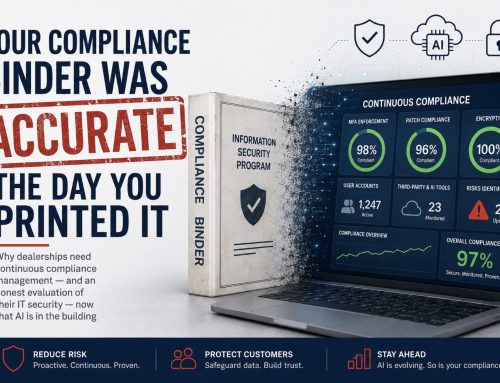
Compliance should never be a binder sitting on a shelf until audit season.
FTC Safeguards Rule requirements, OEM cybersecurity expectations, cyber insurance requirements, and evolving privacy regulations all require dealerships to continuously manage risk—not simply document policies.
Modern dealerships increasingly integrate compliance into their daily operations through:
- Continuous monitoring
- Vulnerability remediation
- Executive reporting
- Security documentation
- Risk assessments
- Security awareness training
- Policy management
- Ongoing operational reviews
The goal isn’t simply passing an audit.
It’s building a more resilient organization.
5. Technology Leadership Creates Competitive Advantage
Perhaps the biggest difference between yesterday’s dealership and today’s modern dealership is how technology decisions are made.
Technology is no longer viewed as an expense to control.
It’s an investment that influences profitability, customer satisfaction, employee productivity, operational efficiency, and long-term growth.
That requires leadership.
Some dealership groups employ an internal CIO.
Others rely on a virtual CIO (vCIO) or strategic technology advisor.
Regardless of the model, successful dealerships make technology decisions based on business outcomes—not just technical requirements.
The question has shifted from:
“How do we keep our systems running?”
to
“How can technology help our dealership perform better?”
Common Technology Mistakes Dealers Make
Many dealerships recognize the importance of modernization but still encounter avoidable challenges.
Some of the most common include:
Adopting AI before preparing data
AI delivers the greatest value when built on accurate, consistent, and well-governed information.
Treating cybersecurity as an IT problem
Cybersecurity is a business risk that affects every department and every customer relationship.
Buying disconnected technology
Individual applications may solve isolated problems, but disconnected systems create inefficiency and reduce visibility.
Ignoring employee adoption
Technology only creates value when people understand how to use it effectively.
Treating compliance as an annual event
Continuous compliance is significantly more effective than preparing only when an audit approaches.
Frequently Asked Questions
What is a modern dealership?
A modern dealership uses technology strategically to improve business performance, strengthen cybersecurity, support compliance, enable AI, and create a better customer experience.
How should dealerships prepare for AI?
Before investing heavily in AI, dealerships should strengthen cybersecurity, modernize cloud infrastructure, improve data quality, establish data governance practices, and ensure compliance programs are operating effectively.
What technology investments should dealerships prioritize?
Most dealerships benefit from focusing on cybersecurity, cloud modernization, Microsoft 365 optimization, identity security, data governance, compliance, and strategic technology planning before expanding AI initiatives.
Is AI replacing dealership employees?
For most dealerships, AI is enhancing employee productivity rather than replacing people. It helps automate repetitive work, improve reporting, summarize information, and support better decision-making.
Why is cybersecurity becoming more important for dealerships?
Dealerships manage significant amounts of customer financial and personal information, making them attractive targets for cybercriminals. At the same time, regulatory requirements and OEM expectations continue to increase, making cybersecurity essential for protecting both the business and its customers.
Becoming an AI-Ready Dealership
Artificial intelligence is changing the automotive retail industry, but successful AI initiatives don’t begin with AI.
They begin with the technology foundation that makes AI possible.
Secure identities.
Reliable infrastructure.
Trusted data.
Modern cloud platforms.
Operational compliance.
Strategic technology leadership.
Together, these capabilities create an AI-ready dealership—one that can confidently adopt new technologies, respond to changing customer expectations, and adapt to whatever comes next.
The dealerships that invest in this foundation today will be better positioned to improve efficiency, protect customer information, accelerate innovation, and gain a lasting competitive advantage.
How Helion Helps
For nearly 30 years, Helion Technologies has partnered exclusively with automotive and heavy truck dealerships to build secure, compliant, and high-performing technology environments.
Our integrated Managed IT, Cybersecurity, Compliance, and Tekion Enablement services help dealerships create the technology foundation needed to confidently adopt emerging technologies, strengthen security, simplify compliance, and maximize the value of every technology investment.
If you’re evaluating your dealership’s technology strategy, we’d welcome the opportunity to help.