
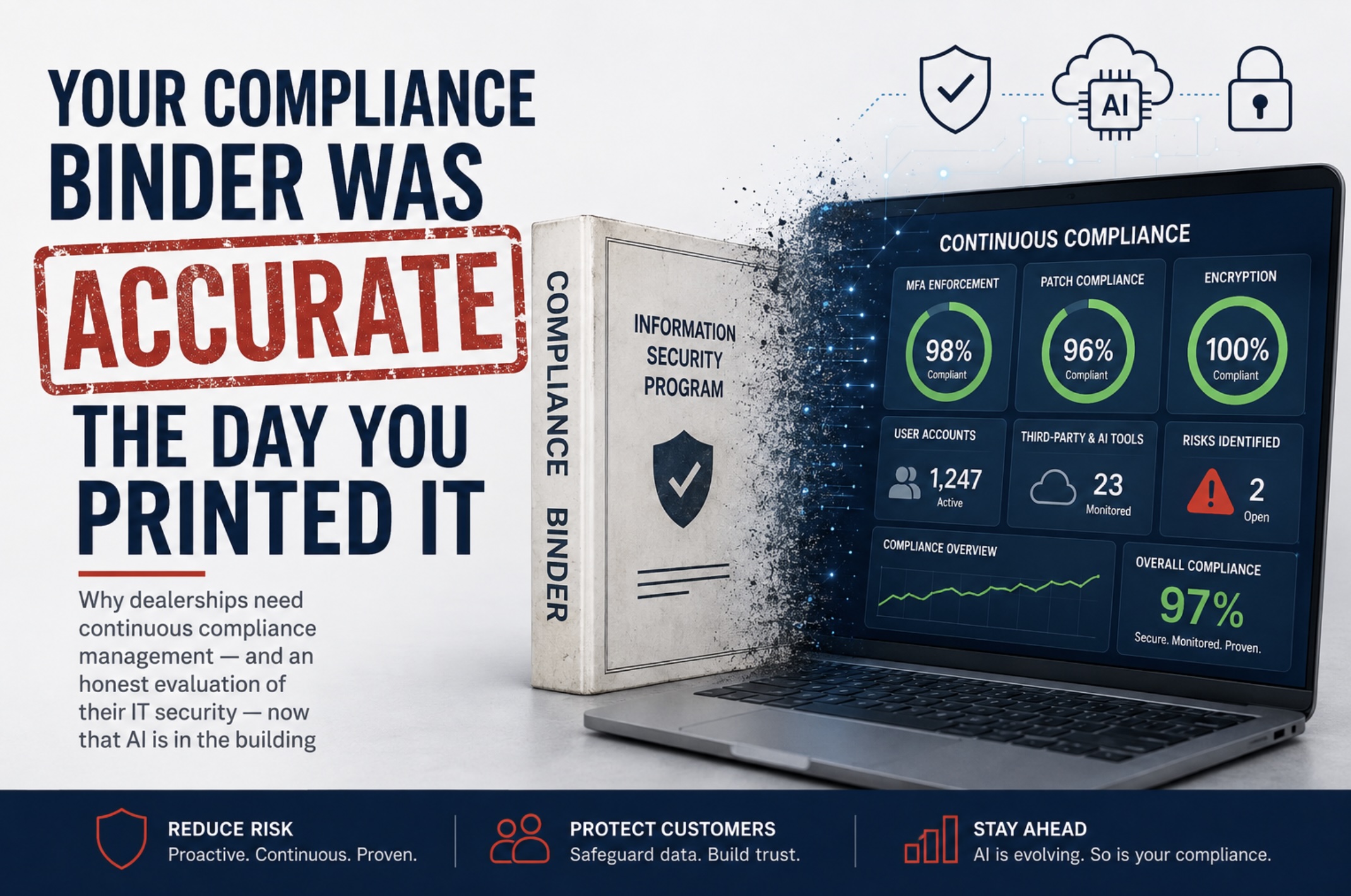
Why dealerships need continuous compliance management — and an honest evaluation of their IT security — now that AI is in the building
Most dealerships I talk to can produce a compliance document. A written information security program, a risk assessment from a vendor, a checklist with satisfying green marks down the right-hand column, maybe a certificate suitable for framing.
Here’s the uncomfortable question I’d ask any dealer principal or CFO reading this: when was that document last true?
Not signed. Not filed. True. As in — the MFA policy it describes is actually enforced on every account today, the encryption it claims is actually turned on across every laptop in the store, and the vendor list it references still matches the vendors currently touching your customer data.
For most stores, the honest answer is “sometime around the assessment date.” And that gap — between what the paperwork says and what the environment is actually doing right now — is where breaches happen, where FTC exposure lives, and where AI is now quietly making everything worse.
The snapshot problem
A point-in-time assessment is a photograph. Your environment is a video.
The moment the assessor closes the laptop, drift starts. A tech disables MFA on a service account to fix a printer issue at 6:45 on a Saturday and never turns it back on. A salesperson leaves and their CRM login stays live. A new vendor gets stood up for a pilot and nobody documents where the data goes. A patch cycle slips in March, then again in April, and by fall a meaningful slice of your endpoints is behind.
None of this is negligence. It’s a dealership operating at speed. But the effect is measurable: configuration drift — changes to infrastructure, access controls, and security settings — begins within days of an assessment, and what passed inspection in January can be seriously non-compliant by March without anyone discovering it until the next scheduled review. The classic pattern is a server patched during the audit window in January, patch management drifting by spring, and a large share of critical systems out of compliance by December — flagged by the auditor, fixed in a panic during audit week, and repeated the following year.
Meanwhile the exposure sat open the entire time. A server that drifted in April stays exposed through October.
That’s not a compliance program. That’s an annual performance of one.
The regulator already made this shift
If you’ve been treating the FTC Safeguards Rule as a documentation exercise, understand that the enforcement posture has changed. The rules themselves haven’t been rewritten — what changed is the FTC’s willingness to wait. The agency has finished extending deadlines and issuing guidance, and dealerships are a stated enforcement priority.
And what regulators want to see isn’t a binder. Today’s examinations focus on proof — how safeguards function in real operations, not how they read on paper. If your controls live in a document but not in daily workflows, you’re exposed. The bar is systems that enforce the right behavior, not policies that hope for it.
There’s also a detail a lot of dealers still miss: since May 2024, the Rule requires financial institutions to notify the FTC of certain security incidents involving customer information. You can’t report an incident within the required window if you don’t have continuous visibility into whether one occurred.
Then AI walked in
Every dealership in America is adopting AI right now, whether leadership authorized it or not. This is where a static compliance program stops being merely outdated and starts being dangerous. Three distinct exposures:
1. Shadow AI — your team is already doing this
Employees adopt AI faster than anyone can vet it. Roughly 47% of generative AI users reach those tools through personal accounts, entirely outside enterprise controls, and the average enterprise logs 223 AI-related data policy violations per month. Only about one in five organizations fully monitors or governs employee AI use.
Translate that to a store. An F&I manager pastes a deal jacket into a consumer chatbot to summarize it. A BDC rep drops a customer’s credit conversation into a free tool to draft a follow-up. A service advisor uses an AI browser extension that quietly has read access to every page — including the DMS. The data problem is that once information has been submitted to an external model, it can’t be retrieved, deleted, or audited, and remediation becomes a legal and breach-notification exercise rather than a technical fix.
Under the Safeguards Rule, that’s nonpublic personal information leaving your control through a channel you never inventoried, never risk-assessed, and can’t produce evidence about.
2. AI vendors are now service providers with deep system access
The AI BDC, the voice agent, the appointment bot — these aren’t marketing widgets. To do anything useful they need write access to your CRM and live access to your DMS. As one buyer’s guide bluntly puts it, outbound consent, opt-out handling, call recording rules, and vendor security controls are non-negotiable in 2026, and dealers are advised to validate actual integration capability with Reynolds, CDK, or Tekion before finalizing any deployment, because API access models differ by platform.
Every one of those integrations is a service provider under 16 C.F.R. § 314.4(f). You’re obligated to select them based on their ability to safeguard customer information, contractually require those safeguards, and periodically assess them based on risk. If your vendor oversight is an annual questionnaire answered by the vendor’s own marketing team, you have documentation, not diligence. The continuous alternative is ongoing monitoring of vendor security posture and attestation status rather than a once-a-year form.
3. AI made the attacker better, too
The same tooling that writes your follow-up emails writes better phishing lures, clones voices convincingly, and compresses reconnaissance from weeks to hours. Your security awareness training from eighteen months ago taught employees to look for typos and awkward grammar. Those tells are gone.
What “truly evaluating your IT security” actually looks like
Not a questionnaire. A demonstration. If you want an honest picture, ask your internal IT team or your current provider to show you, on screen, today:
- Every account without MFA enforced — including service accounts, shared logins, and vendor accounts
- Every endpoint out of encryption or patch compliance, with the age of each gap
- Every user account for employees who no longer work at the store
- A current inventory of every third party and application with access to customer data, including AI tools nobody formally approved
- Backup restore test results — the last actual restore, not the last successful backup job
- Your own written incident response plan, and evidence it was tested rather than filed
- Which AI tools your staff used in the last 30 days and what data went into them
If those answers take two weeks to assemble from spreadsheets and screenshots, that’s your finding. The delay is the risk. Point-in-time evidence stops matching the live environment; screenshots become irreproducible and controls that once appeared compliant fail under scrutiny.
Compliance as an operating program, not an annual project
The fix isn’t a better checklist. It’s changing where compliance evidence comes from and who owns the remediation.
That’s the model we built at Helion. Our Managed Compliance Program is integrated directly with the technology environment we manage — evidence is collected continuously from live dealership systems rather than assembled by hand, controls are validated on an ongoing basis, and when a gap surfaces it doesn’t land on your GM’s task list. It becomes operational work for our Managed IT and cybersecurity teams.
| Traditional compliance | Continuous compliance management |
|---|---|
| Annual or periodic assessment | Continuous monitoring and oversight |
| Questionnaires and manual evidence gathering | Technical evidence pulled from managed systems |
| Findings handed back to the dealership | Findings become remediation work for the IT and security teams |
| Dealership staff track and chase resolution | One integrated team drives issues to closure |
| Focused on documentation | Focused on continuously reducing risk |
| Compliance, IT, and security operate separately | One team, one set of operational data |
| Static report, accurate on the assessment date | Ongoing visibility and executive reporting |
Organizations that make this shift see the practical payoff quickly. Those moving to continuous monitoring have reported audit findings dropping by 50 to 70 percent and audit preparation collapsing from 200-plus hours to 20 or 30 — because the problems were already known and already fixed before anyone came asking. You don’t have to boil the ocean, either: connecting existing tools and automating three to five high-value controls, starting with MFA enforcement and access reviews, establishes the foundation.
The bottom line for dealers
Compliance isn’t a portal, a PDF, or a plaque. It’s the observable state of your technology environment on any given Tuesday — and the ability to prove it.
AI didn’t create this problem, but it has removed whatever margin was left. Your people are moving customer data through tools you haven’t inventoried. Your vendors are connecting AI agents directly into your DMS. Your attackers got a significant upgrade. An annual assessment simply cannot keep pace with any of that.
If you can’t answer the questions in the list above today, in real time, you don’t have a compliance program. You have a compliance artifact — and it stopped being true a long time ago.
Helion Technologies delivers integrated managed IT, cybersecurity, and continuous compliance management exclusively for automotive and heavy truck dealerships, supporting more than 35,000 dealership employees every day. If you’d like an honest evaluation of where your environment actually stands, start the conversation.