
Most dealer management system conversations start in the wrong place. A controller can’t get the report she needs. Service advisors are double-keying into three systems. The parts counter is slow at 7:30 a.m. Somebody in the leadership meeting finally says it: maybe we need a new DMS.
Sometimes that’s right. Often it isn’t — at least not yet. A meaningful share of the pain dealers attribute to their platform is configuration, integration, process, and training debt that accumulated over a decade and will follow the group into any new system that receives it uncleaned. Switching platforms without diagnosing the cause is how a group spends six figures and eighteen months to arrive at the same problems with a different login screen.
So the first question in any dealer management system consulting engagement is not which platform. It’s is this a platform problem or an implementation problem?
Both answers are common. What distinguishes them matters, because the remedies are entirely different — and because when the answer genuinely is platform, the gap between what legacy architecture can do and what a modern one can do is now wide enough to be a competitive issue rather than a convenience issue.
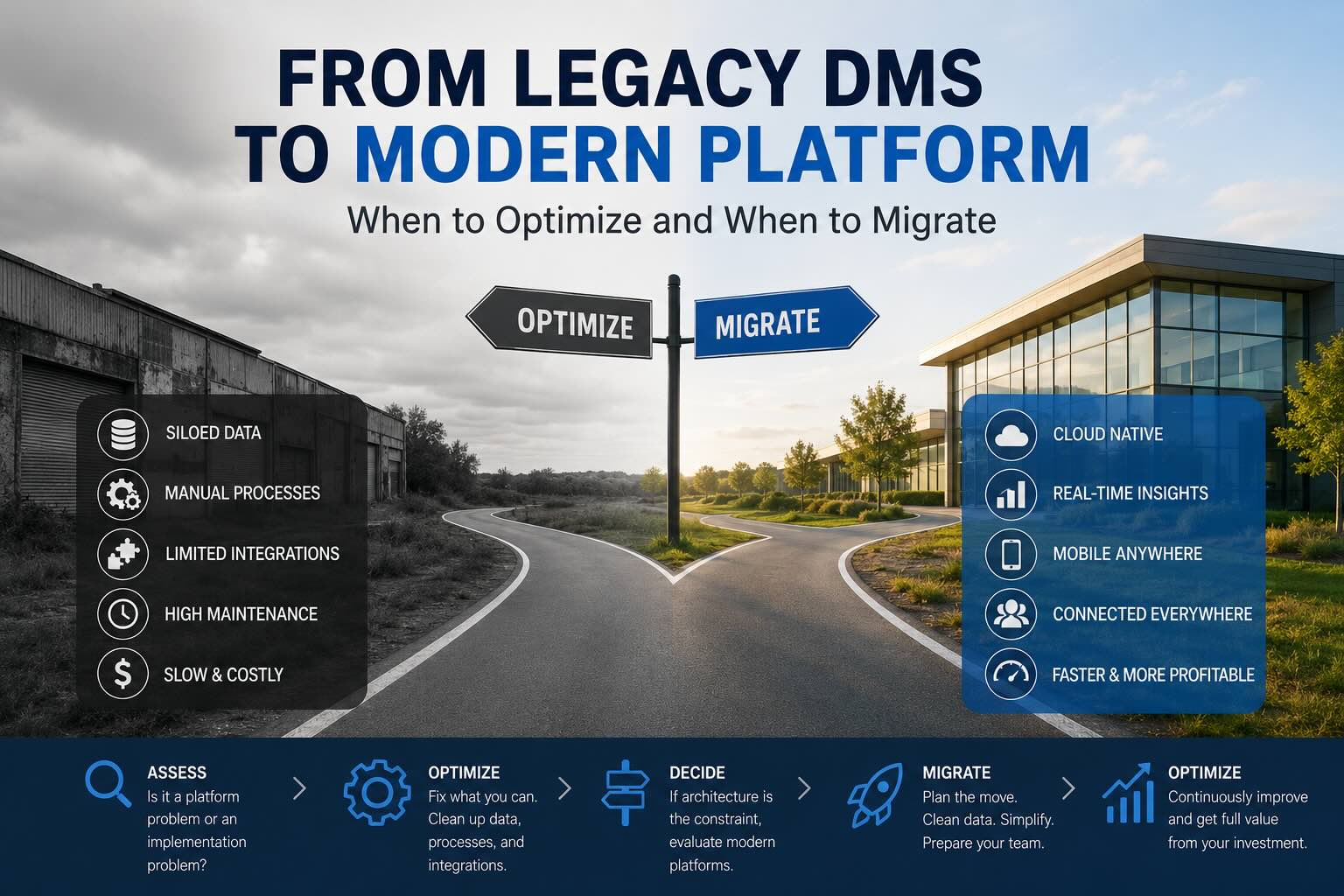
Dealer management system optimization is structured remediation of everything you control inside and around the current system:
- Configuration. Accounting schedules, pay plans, labor rates, op codes, parts pricing matrices, and default workflows set up at go-live by someone who no longer works there and never revisited since.
- Financial statement mapping. A surprising number of “the DMS can’t report on that” complaints turn out to be a factory financial statement mapped incorrectly at one or more rooftops.
- Integration and vendor spend. Every third-party tool touching the DMS costs money in seat fees, integration fees, and data-access fees. Groups routinely discover redundant tools and dead integrations still billing monthly.
- User provisioning. Licenses assigned to departed employees, permissions too broad for compliance comfort, no consistent offboarding.
- Process and training. Two rooftops on the same platform with a 30% spread in fixed-ops throughput is a process finding, not a software finding.
- Data hygiene. Duplicate customer records, inconsistent unit and VIN records, a parts master nobody has cleaned in a decade.
This work is unglamorous, fast, comparatively cheap, and reversible. It is also non-optional if you are migrating, because data conversion moves your mess — it doesn’t clean it. Every group that skips this step and goes straight to a new platform pays for it twice.
When the architecture is genuinely the constraint
Optimization has a ceiling. Past a certain point you’re not fixing a system, you’re compensating for one, and the tell is consistent: the workarounds have become the process.
The specific limits that a configuration pass cannot solve:
Data lives in silos that were never designed to talk. Legacy platforms were assembled over decades — modules bolted on, acquisitions absorbed, middleware layered between them. Sales, service, parts, and accounting each hold a version of the customer. Reconciling them is a monthly project rather than a real-time fact. A modern platform built on a single unified data layer eliminates the reconciliation work entirely, because there is only one record.
Integration is a toll road. On legacy stacks, connecting a third-party tool means a certification program, a per-transaction or per-rooftop data fee, and a feed refresh measured in hours. Open-API architecture changes the economics: real-time endpoints, no middleware tax, and the practical ability to change vendors without changing platforms.
You’re still buying and securing servers. On-premise dependency means hardware refresh cycles, patching, backup verification, and a physical failure domain at every rooftop. Cloud-native means none of that is yours, and updates arrive continuously rather than as scheduled downtime events.
The roadmap doesn’t include what you need. If the capabilities your OEM programs and customers will require in three years aren’t on a committed delivery timeline, optimization is buying time, not solving the problem.
The market has moved on this. Cloud deployment now represents the majority of the DMS market and is gaining share, and the 2024 ransomware incident that took roughly 15,000 dealerships offline for two to three weeks pushed even cost-conscious groups to reevaluate what their architecture actually exposes them to. Two providers still hold something on the order of 70% of the franchise DMS market — but concentration is not the same thing as capability, and dealers are increasingly separating the two.
What “modern” actually buys you
Tekion is the clearest example of the architectural shift, and worth understanding specifically — not because a modern platform is automatically the right answer, but because it defines what the alternative to legacy now looks like.
Built from scratch beginning in 2016 with no legacy code and no on-premise architecture, its Automotive Retail Cloud brings DMS, CRM, fixed ops, parts, accounting, payroll, and digital retailing into a single cloud-native system on one data layer. It runs on roughly 3,000 rooftops, including enterprise groups like Asbury Automotive Group and Ken Garff.
What that architecture produces in daily operation:
- One customer record across every department. Service knows what sales promised. Accounting sees the transaction as it happens rather than at close.
- Real-time OEM connectivity. Factory order status, incentive data, and warranty claims flowing directly rather than through nightly batch and manual re-entry — Tekion’s direct GM integration is the template here.
- Native mobility. Full dealership functionality on a tablet on the drive, not a stripped-down companion app.
- Embedded AI and automation operating on unified data, which is the precondition that makes any of it useful. Machine learning against four disconnected databases produces four disconnected guesses.
- Continuous delivery. New capability arrives without an upgrade project.
- Consolidation opportunity. When CRM, digital retailing, and payroll are native, the third-party stack — and its integration fees — can shrink materially. That’s a real line item in the business case.
Disclosure: Helion is a Tekion Certified Partner.
Getting the most out of the platform you move to
This is where most migrations underdeliver, and it has nothing to do with the software. A modern platform is capability, not outcome. Groups that treat go-live as the finish line get a better-looking version of their old operation.
Design the configuration; don’t replicate it. The single most expensive migration mistake is recreating legacy workarounds in a system that no longer requires them. Every process should be re-justified from scratch. If the answer to “why do we do it this way” is “the old system needed it,” delete the step.
Clean the data before conversion, not after. Deduplicate customers, reconcile the parts master, standardize unit records. Decide deliberately how many years of history convert and in what fidelity — this is a negotiated term, not a technical given.
Rationalize the third-party stack during selection. Inventory every tool, its cost, and its purpose. Determine which are now native, which have real integrations, and which you’re paying for out of habit. Do this before go-live; nobody has appetite to revisit it after.
Verify OEM certification per franchise, in writing. Some manufacturer programs require specific platforms or certified feeds. Confirm coverage for every brand you hold before a decision, not after.
Name adoption owners by department. Not a project sponsor — a fixed-ops owner, a parts owner, a controller. Someone accountable for whether their team actually uses the capability rather than the two screens that most resemble the old system.
Budget for the dip. Expect measurable softness in fixed-ops throughput and deal velocity for 30 to 90 days post-cutover. Sequence around month-end, physical inventory, and the accounting close.
Run a 90-day optimization pass after go-live. Configuration decisions made under implementation pressure are provisional. Revisit them once people know the system. This single practice separates the groups that get full value from the ones that plateau at 60%.
Get reference calls with dealers 12+ months live. Not recent implementations. The variance in dealer experience shows up in post-implementation support, after the go-live team has moved on.
Use the renewal clock
The most common strategic error we see: groups start evaluating alternatives six weeks before an auto-renewal, with no leverage and no time.
Begin the assessment 12 to 18 months before contract expiration. That gives room to complete an optimization pass first, measure whether it resolved the pain, and — if it didn’t — run a real selection process with credible walk-away leverage. It also surfaces the terms that matter early: auto-renewal windows, notice requirements, data extraction rights and fees, and what your data looks like on the way out the door. Extraction cost and format is a term you negotiate at signing, not at separation.
The short version
Do the cheap work first. Optimization resolves more DMS complaints than the industry admits, and when it doesn’t, it makes the migration dramatically better than it would otherwise have been. But when the constraint is architectural — siloed data, metered integrations, on-premise dependency, a roadmap that doesn’t reach where your business is going — no amount of configuration closes that gap, and the groups moving to modern platforms are separating themselves on speed and cost per transaction in ways that compound.
Know which situation you’re in before you sign anything.
Helion works exclusively with franchised auto and heavy truck dealerships across the US. If your DMS renewal is inside 18 months, or you’re weighing a move to a modern platform and want an assessment that isn’t sold by the vendor, let’s talk.
Sources
- Cloud deployment share; 2024 ransomware incident market impact; direct GM integration for real-time order status, incentives, and warranty claims — https://www.persistencemarketresearch.com/market-research/automotive-dealer-management-system-market.asp
- Tekion rooftop count, founding, enterprise accounts, unified architecture — https://www.vendormotive.com/insights/best-dealership-dms-software-2026
- Franchise DMS market concentration (~70%, FTC filing figure); 15,000 dealers offline, two-to-three-week recovery — https://www.ringlead.ca/blog/dealership-ai/reynolds-and-reynolds-review-2026/
- Automotive Retail Cloud module coverage; reference-call guidance for dealers 12+ months live — https://dealersignals.com/insights/tekion-dms-review/
- Cloud-native security posture, automatic updates, mobile capability — https://www.demandlocal.com/blog/reynolds-reynolds-alternatives/