

For the past several years, dealerships have been told that dealership cybersecurity compliance starts with vulnerability scans, self-assessments, policy templates, and compliance software platforms.
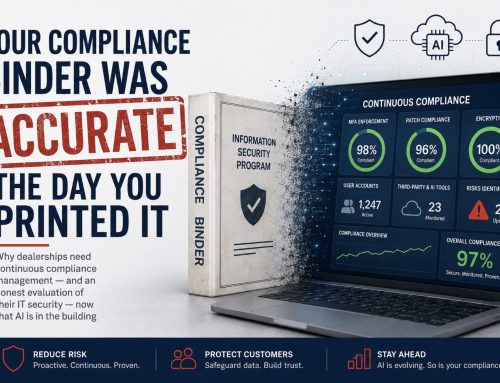
As a result, many dealerships have invested in what could be called first-generation cybersecurity compliance solutions. These platforms typically generate dashboards, risk registers, compliance scorecards, and lengthy reports that identify potential cybersecurity issues.
At first glance, this seems like progress.
But there’s a problem.
Finding risks is not the same as managing risks.
And managing risks is what regulators actually care about.
The Compliance Trap
Many dealerships mistakenly believe they are compliant because they receive regular vulnerability scan reports or because a software platform shows a favorable compliance score.
Unfortunately, dealership cybersecurity compliance doesn’t work that way.
Imagine a dealership performing a vulnerability scan every month. The scan identifies hundreds of vulnerabilities. The report is filed away. The next month, another scan is performed. The same vulnerabilities appear. Another report is generated.
Has risk been reduced?
Has security improved?
Has compliance been achieved?
The answer to all three questions is no.
The dealership has documented its problems, but it hasn’t addressed them.
What the FTC Actually Requires
The FTC Safeguards Rule does not require dealerships to simply identify cybersecurity risks. It requires them to maintain a comprehensive information security program that protects customer information.
That means dealerships must:
- Regularly assess cybersecurity risks
- Evaluate the likelihood and potential impact of those risks
- Prioritize remediation efforts
- Implement safeguards to reduce risk
- Monitor the effectiveness of those safeguards
- Document actions taken
- Continuously update the program as threats evolve
Notice what’s missing from that list:
“Run a vulnerability scan and save the report.”
A scan is only the beginning of the process.
Compliance requires action.
The Difference Between Listing and Assessing
One of the biggest misconceptions in dealership cybersecurity is the belief that vulnerability identification equals risk assessment.
It doesn’t.
A vulnerability scan might identify 500 issues. But not all vulnerabilities present the same level of risk.
Some may have little practical impact. Others may provide attackers with a direct path to sensitive customer information.
True cybersecurity compliance requires organizations to evaluate vulnerabilities in context:
- How likely is exploitation?
- What systems are affected?
- What data is at risk?
- What would be the operational impact?
- What remediation options exist?
This analysis is what transforms a list of technical findings into an actual risk assessment.
Why Many First-Generation Compliance Platforms Fall Short
To be clear, compliance software isn’t inherently bad.
Many platforms provide useful visibility and documentation capabilities.
The problem occurs when dealerships mistake the software for the compliance program itself.
A dashboard cannot prioritize vulnerabilities.
A checklist cannot remediate risk.
A compliance score cannot stop a ransomware attack.
And a report cannot prove that corrective actions were actually taken.
Many dealerships are beginning to recognize this gap. They have invested in compliance platforms yet still struggle to answer a fundamental question:
“How do we actually reduce risk?”
What Next-Generation Compliance Looks Like
The next generation of dealership cybersecurity compliance shifts the focus away from reporting and toward outcomes.
Rather than asking, “How many vulnerabilities do we have?” next-generation compliance asks:
“Which vulnerabilities matter most, and what are we doing about them?”
A next-generation compliance program includes:
Continuous Risk Assessment
Not just identifying vulnerabilities, but evaluating and prioritizing them based on actual business risk.
Remediation Management
Ensuring vulnerabilities are addressed within reasonable timeframes and that corrective actions are documented.
Validation
Confirming that remediation efforts were successful and that risks have actually been reduced.
Continuous Monitoring
Recognizing that cybersecurity is not a one-time project but an ongoing operational process.
Executive Visibility
Providing dealership leadership with meaningful information about risk reduction, compliance status, and program effectiveness.
Compliance and Security Should Be the Same Thing
One of the most dangerous misconceptions in our industry is the idea that compliance and security are separate objectives.
In reality, effective compliance should improve security.
The purpose of the FTC Safeguards Rule isn’t to generate paperwork. The purpose is to protect customer information and reduce risk.
When dealerships focus solely on passing audits or producing reports, they miss the larger objective.
The goal isn’t compliance.
The goal is protecting the dealership, its customers, and its reputation.
Compliance is simply the framework that helps achieve that objective.
The Path Forward
Dealerships don’t need more reports.
They don’t need more dashboards.
And they don’t need longer lists of unresolved vulnerabilities.
What they need is a practical, repeatable process that continuously assesses risk, prioritizes remediation, validates corrective actions, and demonstrates measurable progress over time.
That’s what true cybersecurity compliance looks like.
And that’s why many dealerships are moving beyond first-generation compliance programs and embracing a next-generation approach focused on something far more valuable than documentation: