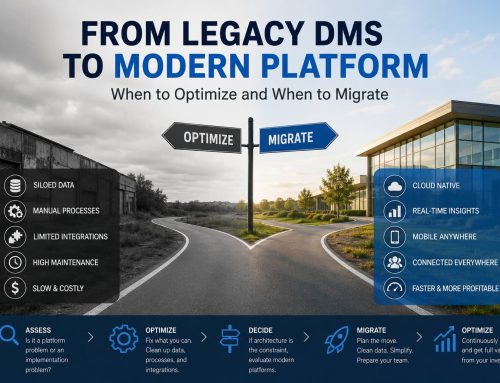


For many auto and truck dealerships, moving to a new Dealer Management System is an exciting milestone. Modern DMS platforms promise improved workflows, stronger integrations, better reporting, and a more connected dealership operation overall. But while most dealerships focus heavily on implementation timelines, training schedules, and operational continuity, one critical area is often underestimated: dealership cybersecurity.
The reality is that a DMS migration is not simply an IT project. It is a major cybersecurity event.
During a DMS transition, sensitive customer and financial data moves between systems, user permissions are rebuilt, vendors gain elevated access, employees operate in unfamiliar environments, and legacy systems are retired or archived. All of this creates opportunity for cybercriminals.
That’s why cybersecurity must be front and center throughout the entire migration process.
And just as importantly, dealerships need to understand that cybersecurity expertise is not the same thing as general IT expertise.
Traditional IT teams are primarily focused on operational continuity — keeping systems running, supporting users, maintaining connectivity, and minimizing downtime. Cybersecurity professionals, on the other hand, are specifically trained to identify vulnerabilities, secure identities and permissions, detect attacker behavior, validate security controls, monitor for threats, and reduce organizational risk during periods of change.
A successful DMS migration requires both.
Without dedicated cybersecurity oversight, dealerships can unknowingly introduce major security gaps during implementation that attackers may later exploit.
1. Insecure Data Migration
One of the biggest dealership cybersecurity risks during a DMS transition involves the movement of sensitive data.
Customer records, credit applications, payroll information, banking details, driver’s license information, and other Personally Identifiable Information (PII) are often extracted, transferred, staged, validated, and reloaded across multiple environments during migration.
Without proper cybersecurity controls, this creates significant exposure.
Cybersecurity professionals play a critical role in securing this process by:
- Validating encryption standards
- Securing temporary migration environments
- Monitoring for unauthorized access attempts
- Verifying secure transfer protocols
- Conducting post-migration data integrity validation
- Identifying exposed repositories or insecure configurations
These are highly specialized cybersecurity functions that extend far beyond simply “moving data” from one platform to another.
Dealerships should ensure that all migration-related data is encrypted both in transit and at rest and that access to migration environments is tightly restricted and monitored throughout the process.
2. Excessive User Permissions During Setup
Modern cloud-based DMS platforms often require dealerships to completely redesign user roles, permissions, workflows, and integrations.
During implementation, many dealerships temporarily provide broad access permissions simply to accelerate setup and reduce operational friction. Unfortunately, this creates serious dealership cybersecurity risk.
Cybercriminals thrive on excessive permissions. If a phishing attack compromises even one employee account during the migration, attackers may gain access to sensitive systems far beyond what should have been possible.
Cybersecurity professionals bring specialized expertise in:
- Identity and access management
- Role-based access controls
- Least-privilege security models
- Multi-Factor Authentication (MFA) strategy
- Privileged account monitoring
- Access auditing and validation
These skills are critical during a DMS migration because improper permissions are one of the easiest ways attackers gain lateral access inside organizations.
Strong dealership cybersecurity requires careful access design from day one — not temporary shortcuts that later become permanent vulnerabilities.
3. Leaving Legacy Systems Behind Unsecured
One of the most overlooked dealership cybersecurity issues occurs after the migration is complete.
Old DMS servers, backup systems, archived databases, storage devices, and retired workstations are frequently left behind unsecured or improperly decommissioned. These forgotten systems often contain years of sensitive dealership and customer data.
Cybercriminals actively search for these “legacy system graveyards” because they commonly contain:
- Unpatched vulnerabilities
- Weak or dormant credentials
- Outdated operating systems
- Misconfigured remote access
- Sensitive archived data
Properly retiring old infrastructure requires cybersecurity expertise in:
- Secure data destruction
- Data retention and archival strategy
- Vulnerability identification
- Network segmentation
- Endpoint security
- Access removal validation
Simply unplugging an old server does not eliminate cybersecurity risk.
A successful DMS migration should always include a formal cybersecurity-led decommissioning strategy to eliminate hidden exposure from legacy environments.
4. Vendor and Third-Party Integration Risk
Modern DMS platforms rely heavily on integrations with CRMs, OEM systems, lender portals, inventory platforms, payroll providers, digital retailing solutions, and countless third-party applications.
Each integration creates another potential attack path.
This is why dealership cybersecurity during a DMS migration must include extensive vendor risk evaluation.
Cybersecurity professionals are trained to assess:
- Vendor security architecture
- Encryption standards
- MFA enforcement
- Incident response maturity
- Third-party access controls
- Compliance practices
- Supply chain security exposure
Many dealerships evaluate vendors primarily on functionality and operational fit. But cybersecurity professionals understand that even one poorly secured third-party integration can create exposure across the entire dealership environment.
A successful DMS migration requires careful evaluation of not only the DMS platform itself, but the entire connected ecosystem surrounding it.
5. Employee Vulnerability During Transition
One of the biggest dealership cybersecurity risks during a DMS migration involves employee confusion and transition fatigue.
Employees learning new workflows while trying to maintain daily operations become significantly more vulnerable to phishing attacks and social engineering scams.
Attackers know employees are expecting:
- Password reset requests
- MFA enrollment prompts
- Vendor communications
- Training emails
- New login procedures
This makes fraudulent emails far more believable during a transition period.
Cybersecurity professionals understand how attackers exploit human behavior during organizational disruption and can implement:
- Transition-specific phishing awareness training
- Simulated phishing exercises
- Security communication protocols
- Identity verification procedures
- Threat monitoring during implementation
This type of human-focused cybersecurity preparation is often the difference between a smooth migration and a serious security incident.
6. Treating the Migration as an IT Project Instead of a Cybersecurity Event
Perhaps the biggest mistake dealerships make during a DMS migration is viewing the transition strictly as an operational or IT initiative.
A DMS migration fundamentally changes:
- Data flows
- User identities
- Access permissions
- Vendor connectivity
- Cloud integrations
- Endpoint configurations
- Authentication processes
Every one of these changes carries cybersecurity implications.
This is why cybersecurity must remain front and center throughout the migration lifecycle — from vendor evaluation and planning through implementation, testing, go-live, and post-migration monitoring.
Successful dealership cybersecurity during a DMS migration often requires specialized expertise in:
- Identity security
- Threat detection and monitoring
- Incident response planning
- Vulnerability management
- Secure cloud architecture
- Security configuration management
- Network segmentation
- Endpoint protection
- Security operations monitoring
These are specialized cybersecurity disciplines that go well beyond traditional IT administration.
Final Thoughts
Moving to a new DMS can absolutely improve dealership operations, efficiency, and customer experience. But it can also create significant cybersecurity exposure if security is not deeply integrated into the migration strategy.
The dealerships that navigate DMS transitions most successfully are typically the ones that recognize a critical reality:
A successful DMS migration requires both operational expertise and cybersecurity expertise.
Because while IT teams help keep the migration moving, cybersecurity professionals help ensure the migration does not unintentionally create new vulnerabilities, expose sensitive data, or leave dangerous gaps behind.
In today’s environment, dealership cybersecurity cannot be an afterthought during a DMS transition.
It must be part of the strategy from the very beginning.