

Most executives understand that dealership cybersecurity compliance is important. You’ve likely invested in tools, policies, and maybe even completed an audit or two. On paper, everything looks good.
But here’s the uncomfortable truth: many dealerships are approaching dealership cybersecurity in a way that looks right—but leaves them exposed.
The Problem: Compliance Has Become the Goal
For many dealerships, cybersecurity starts and ends with compliance. The focus becomes:
- Do we have policies documented?
- Have we checked the required boxes?
- Can we pass an audit?
While these are important, they were never meant to be the end goal.
The FTC Safeguards Rule doesn’t say you need documentation that suggests security exists.
It requires that you implement and maintain a comprehensive information security program.
That’s a big difference.
It means cybersecurity isn’t something you prove once a year—it’s something you actively do every single day.
Why Traditional Compliance Falls Short in Dealership Cybersecurity
Compliance frameworks are helpful—but they have limitations that can create dangerous blind spots.
They are:
- Static – They define what should exist, not how it performs in real-world conditions
- Point-in-time – Audits capture a moment, not ongoing activity
- Checklist-driven – Focused on presence, not effectiveness
For example a traditional compliance audit:
- May confirm you have a firewall – but it won’t tell you if it’s properly configured to stop today’s threats.
- May confirm multi-factor authentication (MFA) is deployed – but not whether it’s being bypassed or inconsistently enforced.
- May verify tools are installed – but not whether anyone is actively monitoring them.
In short, compliance often overlooks context, behavior, and real-time risk.
The Stakes Are Rising for Dealership Cybersecurity
Dealerships are prime targets for cybercriminals. Why? Because you manage:
- Customer financial data
- Credit applications
- Driver’s license and identity information
- Banking and lender integrations
And now, with the growth of AI tools, cloud systems, and integrations, your attack surface is expanding rapidly.
Cybercriminals aren’t checking your compliance documentation.
They’re looking for:
- Misconfigurations
- Unmonitored systems
- Gaps between tools and actual usage
A Sign of What’s Coming: Mercedes-Benz and ISO Audits
We’re already seeing a shift in expectations. Manufacturers like Mercedes-Benz are now requiring dealerships to prove their cybersecurity maturity through ISO-based audits.
This isn’t about documentation. It’s about demonstrating that your dealership is actually operating a real, functioning security program. And importantly—this isn’t a quick fix. You can’t stand up a comprehensive security program overnight.
It requires:
- Processes
- Technology
- Continuous monitoring
- Trained people
This move is a clear signal: “Checkbox compliance” is no longer enough.
The Better Approach: Risk-Based Dealership Cybersecurity
High-performing organizations are shifting to a risk-based approach to dealership cybersecurity.
Instead of asking: “Do we have this control in place?”
They ask:
- “Is it working?”
- “Is it protecting us from current threats?”
- “Where are we most vulnerable right now?”
This approach focuses on:
- Continuous monitoring instead of periodic reviews
- Real-world threat detection instead of static controls
- Prioritization of risk instead of equal treatment of all issues
It connects cybersecurity to actual business risk—not just compliance requirements.
Bridging the Gap: Integrating Security and Compliance
The strongest dealership cybersecurity strategies don’t ignore compliance—they build on it.
Think of compliance as the baseline, not the finish line.
The key is integration.
Instead of:
- Security work happening in one place
- Compliance documentation happening in another
They must be connected.
For example:
- Security activities should automatically feed compliance reporting
- Monitoring and response efforts should support audit readiness
- Daily operations should align with regulatory expectations
This ensures that:
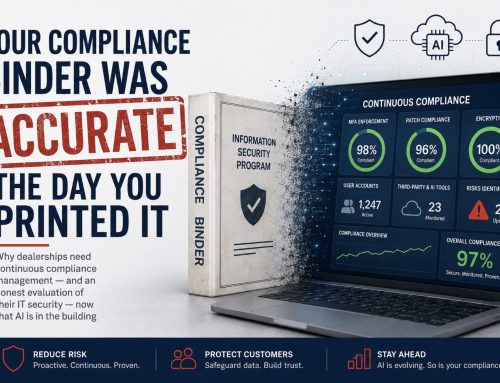
- What you document reflects what you actually do
- And what you do improves your real security posture
Compliance Doesn’t Stop Breaches—Security Does
Compliance is important. It helps you meet regulatory requirements and demonstrate accountability.
But it doesn’t stop cyberattacks.
Your security posture does.
For dealership executives, the takeaway is simple: If your current approach to dealership cybersecurity is centered on passing audits or checking boxes, it’s time to rethink the strategy.
The goal isn’t to prove you’re secure. The goal is to actually be secure.